
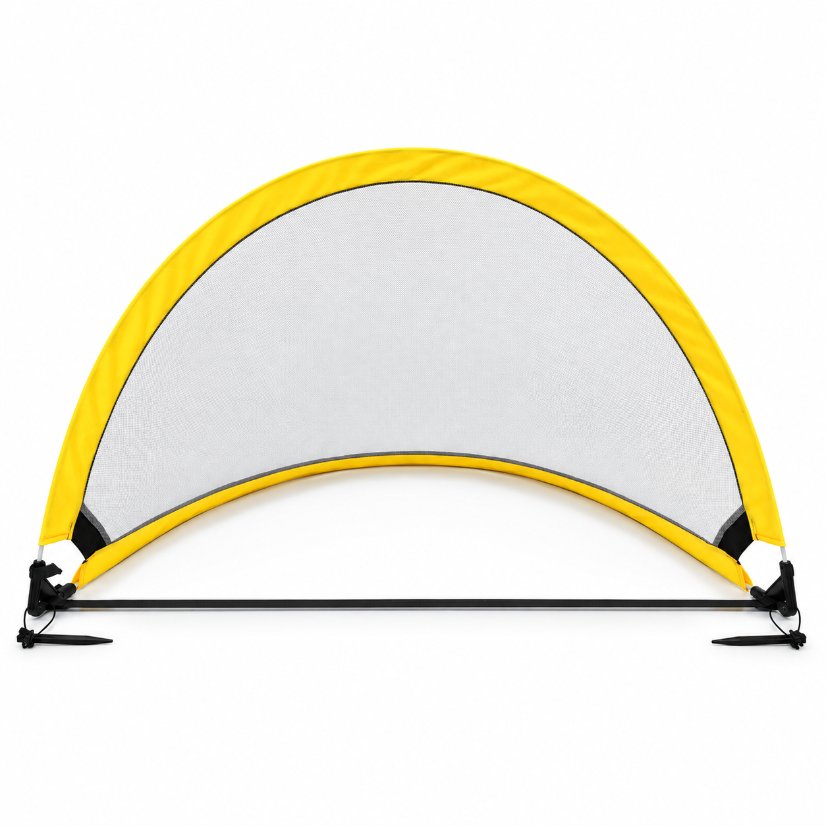
For a soccer goal net attachment RFQ, identify the exact goal reference, mark each connection area on a drawing or photograph, and request matching sample details from the supplier. Approve the net and frame as a specified combination. Record which attachment elements are supplied, which remain connected during packing, and which require a separate supplier instruction before confirming the order.
Start with the pictured goal, then define the inquiry
Yijia Leisure lists a Semi-Circular Soccer Goal with a yellow-looking outer border and a net visible in its catalogue image. Use that product name and photograph to identify the reference in your inquiry. A distant image cannot establish whether a particular area uses a sewn channel, loop, clip, tie or another connection. Those details need a supplier response tied to the quoted item.
Write down the version you want the supplier to explain before comparing quotations. If a purchasing team sends only the words soccer goal net, one respondent may discuss the complete goal while another discusses a replacement component. State whether the inquiry concerns the complete goal, its net, or a proposed change to the net attachment. Keep those scopes on separate quotation lines.
Create an attachment map that both teams can reference
Place simple location labels on the reference photograph. For example, a buyer might mark the curved upper edge, lower edge and corner areas, then ask the supplier to identify the construction at every marked location. These labels are a communication aid. They do not assert that the pictured product has detachable connections at those points.
Request a complete view and a close view that share the same item identifier. The complete view shows where the detail belongs; the close view helps explain what is present. Ask the supplier to include an opposite-side view when the connection is hidden by a border or overlap. Record unresolved areas as questions instead of completing the map from appearance alone.
Compare the evidence needed for each purchasing question
The useful comparison is between the questions your order needs answered. A connection photograph, a supplied-parts list and an assembly instruction serve different purposes. Request the appropriate evidence for each question and connect every response to the same sample reference. This prevents a clear photograph from being accepted as an answer to an unrelated packing or replacement question.
Buyer question | Supplier confirmation to request | Approval record
Where does the net connect? | Marked complete view and corresponding close details | Location labels with image references
What arrives with the order? | List of the supplied connection elements | Quotation line and packing description
What stays attached in the package? | Packed-state photographs for the quoted version | Packed-state reference identifier
Can a net be ordered separately? | Explicit offered replacement scope and matching-item reference | Separate component quotation if offered
Separate visible construction from unverified performance
A close photograph may show an attachment’s shape, position or visible stitching. It cannot by itself verify holding strength, repeated-use life or suitability for a particular environment. Describe the visible feature neutrally and ask the supplier to state its intended function. If your purchase requires measured performance, agree on the requirement and appropriate supporting evidence separately.
Avoid writing a material identity or a test conclusion into the RFQ because an element looks familiar. Dark corner details in a catalogue picture may help locate a question, but their composition and function still need confirmation. Equally, the product name does not establish a competition standard, age category or installation approval. Keep those decisions outside the appearance approval unless specific evidence is supplied.
Clarify removable parts without assuming removability
Ask whether the supplier offers the quoted net as a separately removable component or as part of a particular assembled configuration. A buyer should not assume that every visible connection is intended to be opened. If the supplier describes a removable arrangement, request its approved instructions and a list of the matching pieces before making that arrangement part of the order.
Replacement inquiries need an especially clear item link. Provide the original item identifier and ask the supplier to confirm whether the proposed replacement matches it. Matching outline alone does not prove matching connections. If the supplier cannot confirm compatibility, keep the replacement line pending rather than accepting a generic net description as an interchangeable part.
Keep sample approval and packing approval connected
Once the supplier answers the attachment questions, retain an annotated version of the approved sample record. Identify the complete-view image, close-detail images and written supplied-parts list together. Record the version date and the supplier’s item reference. The purchasing team can then point to the same record when it checks a later quotation or discusses a proposed change.
Request the quoted packing state separately, including which pieces remain attached and which are packed apart if applicable. A photographed assembled sample does not establish how goods will arrive. Ask for a revised approval record if the supplier proposes a different attachment or packing configuration. Do not let an unchanged marketing image conceal a change in what the quotation covers.
• Identify the catalogue goal and specify complete-goal or component inquiry scope.
• Mark connection locations and request details tied to the same sample identifier.
• List unresolved construction, supplied-part and packed-state questions separately.
• Retain written confirmation with the approved image version before issuing the order.
Frequently asked questions
Does a catalogue image confirm the net attachment method?
It can identify areas to discuss, but it does not establish the full connection method. Request location-specific details and written confirmation for the exact quoted item. Hidden sides and packed configurations may require additional supplier photographs.
Should a complete goal and a replacement net share one RFQ line?
Use separate lines when both are under consideration. State the item each line must match and ask the supplier to confirm the offered scope. This makes a complete-product quotation distinguishable from a component-only quotation.
Can visible attachment details establish strength or compliance?
Appearance approval does not verify performance or compliance. Define any required assessment separately and request evidence appropriate to the quoted configuration. Do not convert visible stitching, colour or shape into a test result.
What should the final approval record include?
Keep the exact item reference, annotated connection map, matching detail photographs, supplied-parts description and agreed packing state together. Record any remaining questions as open items so an unanswered detail is not silently treated as approved.
Product and contact references
Catalogue reference: confirm matching item: https://yijialeisure.com/product/%e5%8d%8a%e5%9c%86%e7%90%83%e9%97%a8/
Related catalogue reference: https://yijialeisure.com/product/%e6%96%b9%e5%bd%a2%e7%90%83%e9%97%a8/
Contact Yijia Leisure: https://yijialeisure.com/contact/
Yijia Leisure blog: https://yijialeisure.com/blog/